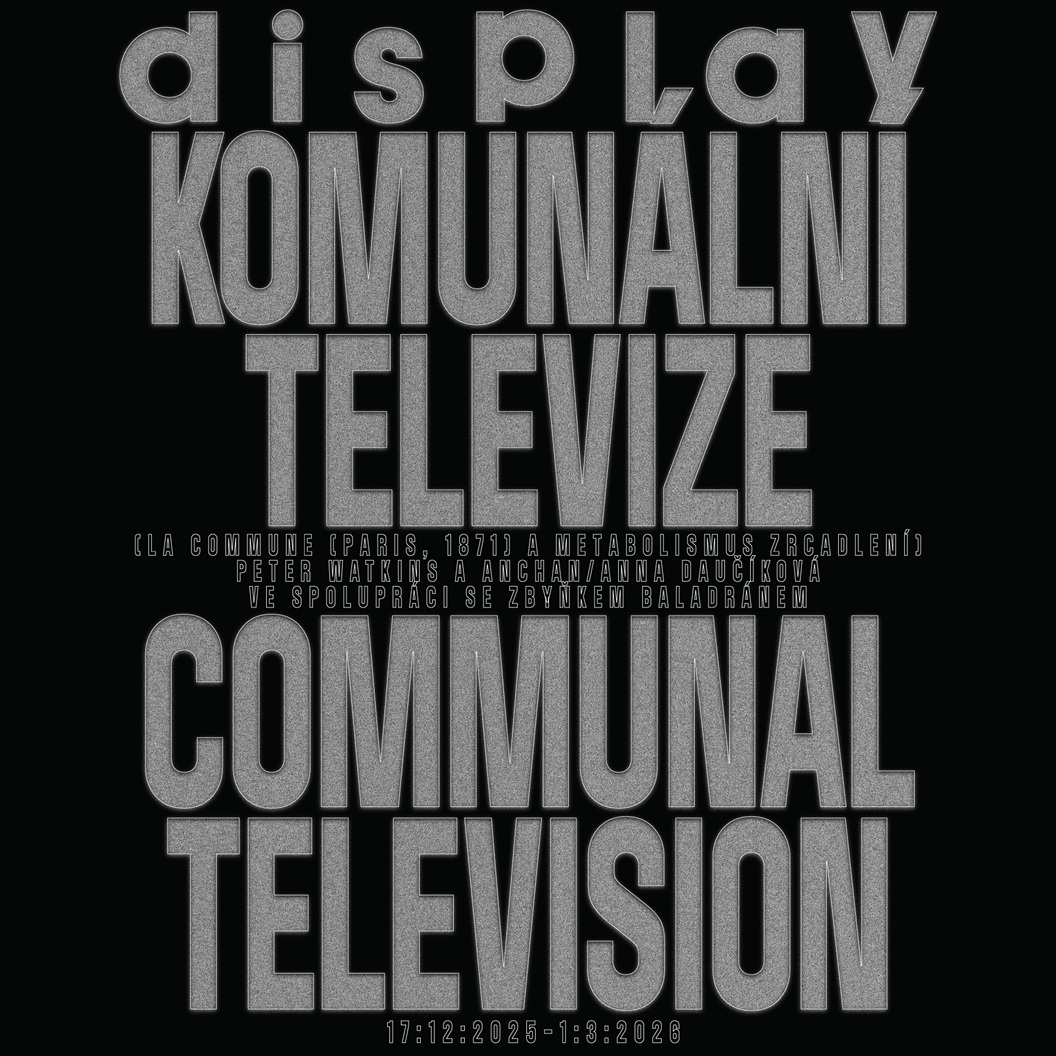
Komunální televize
In a peculiar way, the world is being shattered into many disparate fragments. Finding what is common is becoming increasingly more difficult in the era of prevailing individualism. It seems that in the age when we communicate with each other as “users”, it is not quite clear who profits from this individualism. In such a situation, can we even imagine politics that could disrupt the described movement or attempt to reverse it?
…
The exhibition presents and details the possibilities of collective action. The title Communal Television was chosen as a metaphor, an attempt at a projection of collective imagination into a comprehensible catchword. Communal television is a counterpoint to centralized mass communication, once based on frontal and hierarchic principles, but rather decentralised and hyperindividualistic today. Communal television represents something specific – interests and contents that have their own speakers and dialogic structure. It also refers to the artistic approaches demonstrated at the exhibition of the presented film La Commune (Paris, 1871) where it is precisely “newscasting” that frames the events of the Paris Commune in 1871. In his work, Peter Watkins, who recently passed away, theoretically reflected and developed the film techniques exposing the nature of mass media and their impacts on the society and politics. He argued that “each man, woman and child have a fundamental right for alternative forms of non-violent, non-commercial, non-hierarchic mass or local audiovisual media.“ And if they wish to do so, they should have the right to shape such a medium. He was convinced that communication involves a reciprocal sharing process and dialogue between parties and that the so-called mass communication should also operate in this way. It seems as if the development in recent years affirms his claim – today, almost everyone has the possibility to create and share his or her own content. However, as a result of that mutual communication has become more complicated and the possibility for mutual sharing of political ideas was rendered virtually impossible. We are still facing the same format of manipulation and propaganda as the one before the digital era, only in different, more complex conditions. In an era marked by the monopolization of communication channels, the expansion of algorithmic platforms, and the increasing monetization of their users, it seems almost like a joke to speak of political agency within these very systems.
…
Screening a live-action film, which was originally made for cinemas and television, in a gallery space is quite uncommon. But only seemingly: exhibition environment offers a different viewing experience and compared to cinema, where the visitor sits and contemplates what is on the screen alone as a member of a crowd, the viewers in a gallery can move freely, indulge in a discussion or directly interact with the artworks. The environment is closer to that of a television studio or club than to the cinema environment. A suitable environment for the rereading of an essential film of world cinema. …
In the second part of the exhibition, the work of Anchan/Anna Daučíková titled Metabolism of Reflection confronts us with an unusual updated rendering of Watkins’s film. Uncommonness happens to be an accompanying phenomenon of the artist’s work in general. Her artistic approach may be described as dialogic countermovement. The artist herself, always in person, in a countermovement of sorts, a reflection. One could randomly pick several examples from her life which testify to this approach. For example moving to the Soviet Union at the end of the 80s socialist era. The practice of painting pictures aimed at the disavowal of the authorial principle. Pursuing radical feminist activism in Slovakia, a country that decided to return to its Catholic roots. A trained glassmaker redefining the standards of moving picture on the international art scene. Or insisting on non-binarity as a fundamental principle of human relationships in the era of manichaeistic simplifications. Just as Peter Watkins contributed to the critique of new media through the very methods applied by them, so does Anchan/Anna Daučíková suggest her own metabolic reflection of present-day protests. The universe can no longer be perceived through the logic of Cartesian binaries. The projection of present-day protest gatherings on the wall of the gallery is perceived by us not only as a display of ideological animosities, but also as a revelation of the cyclical movement of interdependencies, reactions and efforts of coping with unexpected events. And that can be done only collectively. To learn together, to react together and act together. It encourages the viewers to initial action and to reflect its role, while the of Paris communards still echo in the ears.
… What happened in Paris in 1871 is in many aspects unprecedented. The status quo of the Second French Empire collapsed and the state power fell into the arms of broad masses of the people almost without a fight. As it later turned out, the rise of social and cultural emancipation became an easy prey for the following reaction of the restored regime, now dressed in the coat of a republic. The Commune was massacred and very soon marginalized and intentionally suppressed in the public space and in its memory. The uniqueness of the Commune consists in its emancipatory radicality, its fight against private ownership, its democratic aspects in the social and economic areas or in the politics of free education for all without the influence of the church. As if the unfinished project of French revolution rose again and tried to culminate exactly where it was halted. Peter Watkins mapped several months of the Commune’s existence by means of interviews with its participants, represented by both actors and non-actors from the outskirts of Paris as well as illegal immigrants. He gave them the possibility to complement the script with their own ideas and experience in the world today. This process gave rise to a film that is a vast fresco composed of many voices – assembling motives of various participants – yearning for a more just and safer world. A quarter century later, Anchan/Anna Daučíková updates these voices and reinforces them with experience of global protests reflected at the exhibition in our digital devices and in the rear mirror of the projector, inviting us to assume a new perspective and contemplate the possibilities of communal events.
📸: Jan Kolský